
Borrowed Confidence
On the quiet responsibility of being someone’s senior

Every doctor remembers two seniors.
The one who made them afraid.
And the one who made them believe they belonged.
They are almost never the same person.
Medicine has always been an apprenticeship.
We inherit anatomy from cadavers.
Physiology from lectures.
Protocols from guidelines.
But courage is inherited from people.
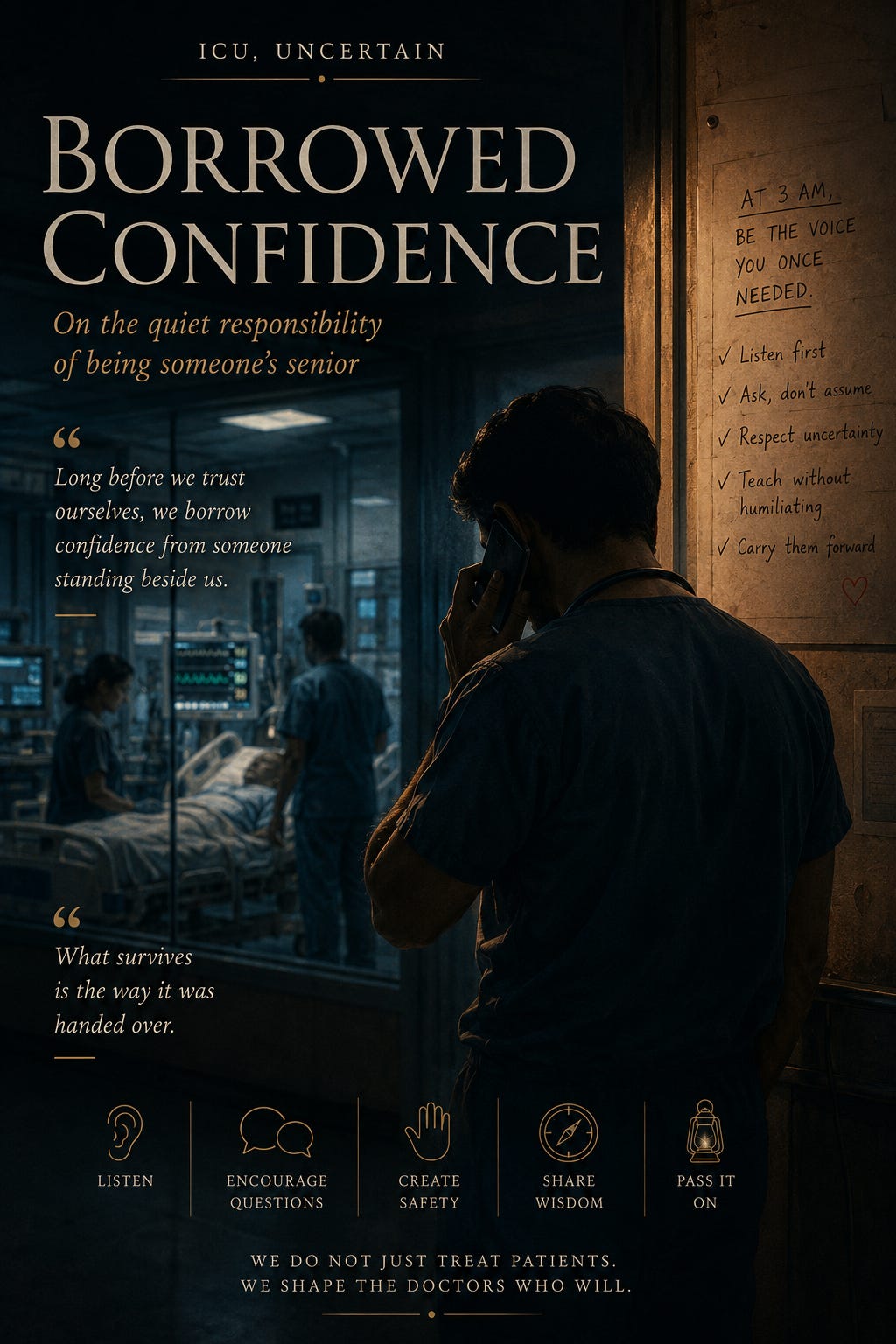
Long before we trust ourselves, we borrow confidence from someone standing quietly beside us.
Someone who watches a trembling hand hesitate over an arterial line and says,
“Go ahead.”
“I am right here.”
Most of us never notice the exchange.
For years afterwards, we practise medicine on borrowed confidence—spending what somebody else first placed in our hands.
Somewhere tonight, a junior doctor is standing outside an ICU with a phone in their hand.
It is 3:07 in the morning.
A patient’s blood pressure has begun to drift.
The ventilator no longer looks quite right.
Something feels wrong, though they cannot yet explain why.
The number has already been dialled once.
Cancelled.
Dialled again.
Cancelled again.
They are not rehearsing a clinical presentation.
They are rehearsing the first sentence.
Because experience has taught them that the voice answering the phone often matters as much as the advice that follows.
I have often wondered why some ICUs feel lighter than others.
The patients are no less sick.
The nights are no shorter.
The alarms sound exactly the same.
Yet in some units, a nurse interrupts rounds.
“Are we sure about that dose?”
The consultant pauses.
Looks again.
Nobody feels embarrassed.
A resident suggests a diagnosis that turns out to be wrong.
The discussion continues anyway.
No shaming follows.
The following morning, that same resident volunteers another possibility without hesitation.
Just because their voice was not dialled down.
After a difficult death, someone quietly puts the kettle on.
For ten minutes nobody pretends to have another job waiting.
The grief is shared before the work resumes.
In those places, learning feels strangely effortless.
Not because mistakes happen less often—
Because mistakes are allowed to remain teachers instead of becoming verdicts.
Other units feel different.
Questions arrive wrapped in apologies.
“Sorry… this is probably a stupid question…”
Silence slowly replaces curiosity.
Praise becomes scarce.
Correction becomes public.
People begin protecting themselves instead of protecting their patients.
No policy announces the change.
It settles over the unit quietly, one conversation at a time.
There is a persistent belief in medicine that excellence and intimidation are close relatives.
They are not.
Excellence asks for standards.
Intimidation asks only for silence.
One produces better doctors.
The other produces quieter ones.
And in intensive care, silence is rarely benign.
Every registrar knows the arithmetic performed before a late-night phone call.
Can this wait?
Am I overreacting?
Will they think I’m incompetent?
Should I have known this already?
By the time the consultant answers, half the clinical decision has already been made—not at the bedside, but in the mind of the person holding the phone.
Whether uncertainty is spoken aloud depends remarkably little on the junior doctor.
It depends almost entirely on what uncertainty has been taught to expect.
The best units I have worked in shared one quiet characteristic.
Nobody was expected to know everything.
There is a particular silence that follows a consultant saying,
“I don’t know.”
It is not the silence of uncertainty.
It is the silence of permission.
Permission to think.
Permission to question.
Permission to discover the answer together instead of pretending it already exists.
That may be one of the safest sentences ever spoken in an ICU.
When I was younger, I believed becoming a good senior meant becoming the smartest person in the room.
Experience corrected me—usually at my own expense.
The seniors I remember most vividly were rarely the quickest to answer.
They were the ones around whom everyone else became more thoughtful.
Rounds lasted longer because more people spoke.
Nurses challenged decisions.
Residents defended differential diagnoses.
Medical students asked questions without apologising for asking them.
You left those rounds intellectually tired but somehow more confident than when you arrived.
Looking back, I realise that confidence had never been mine.
It had simply been lent to me for a while.
Medicine has a dangerous habit of romanticising its own hardships.
Many of us are trained in environments where humiliation masqueraded as teaching.
Some survived because of it.
Far more survived despite it.
Time has a curious way of polishing painful memories until they begin to resemble tradition.
We convince ourselves that fear made us meticulous.
That public embarrassment produced resilience.
Perhaps it sharpened some people.
It also silenced others who might have become extraordinary doctors.
Cultures are inherited far more easily than they are questioned.
No one tells you when you become a senior.
There is no ceremony.
One day a medical student’s eyes search for yours before the needle touches skin.
A resident pauses halfway through presenting a case, waiting to see whether curiosity will be rewarded or punished.
A nurse turns towards you before anyone else when the monitor alarms.
Almost without noticing, you realise someone has started borrowing confidence from you.
Authority changes in that moment.
It stops being something you possess.
It becomes something you owe.
I have forgotten countless elegant diagnoses.
Entire conferences have dissolved into memory.
Research that once felt revolutionary has quietly become history.
Yet I remember almost every senior who changed the way I thought.
Not because they knew more.
Because they made it possible to believe that one day I might know enough.
They corrected without humiliating.
Questioned without diminishing.
Expected excellence while forgiving imperfection, often in the same conversation.
Years later, I realise they were teaching something much larger than medicine.
They were teaching what medicine should feel like.
Publications date out.
Titles retire.
Committees dissolve into minutes nobody ever reads.
But somewhere years from now, a doctor we once trained will pause before correcting a resident.
They will wait an extra moment before dismissing an uncertain question.
They will reassure a frightened family in a quiet corridor.
Perhaps, in the middle of the night, their phone will ring.
On the other end will be a young doctor rehearsing a first sentence.
They will answer without irritation.
Without theatre.
Without making uncertainty feel like failure.
Perhaps they will simply say,
“Tell me what’s happening.”
Neither of them will realise that medicine is being handed from one generation to the next.
Not through the advice that follows.
But through the voice that chose to listen.
P.S. Confidence may be the only thing in medicine that grows by being given away.
Long after our knowledge has become outdated, our way of teaching will continue practising medicine in people who no longer remember where they learned it from.
Very thought provoking
Insightful. Thank you.